
SoftwareMining •
COBOL to Java & C#
• Predictable & Repeatable
One of the most common concerns in a COBOL modernization project is the amount of testing required. Existing business scenarios, test data and expected results can often be reused because the original COBOL application provides the behavioural baseline against which the translated application can be validated.
SoftwareMining's automated, rule-based COBOL-to-Java and COBOL-to-C# Translation Toolkit generates maintainable Java or C# code and provides translation and testing features that support repeatable functional-equivalence testing. The original and translated applications can be executed using the same representative data, allowing files, reports, database updates, return codes and transaction results to be compared.
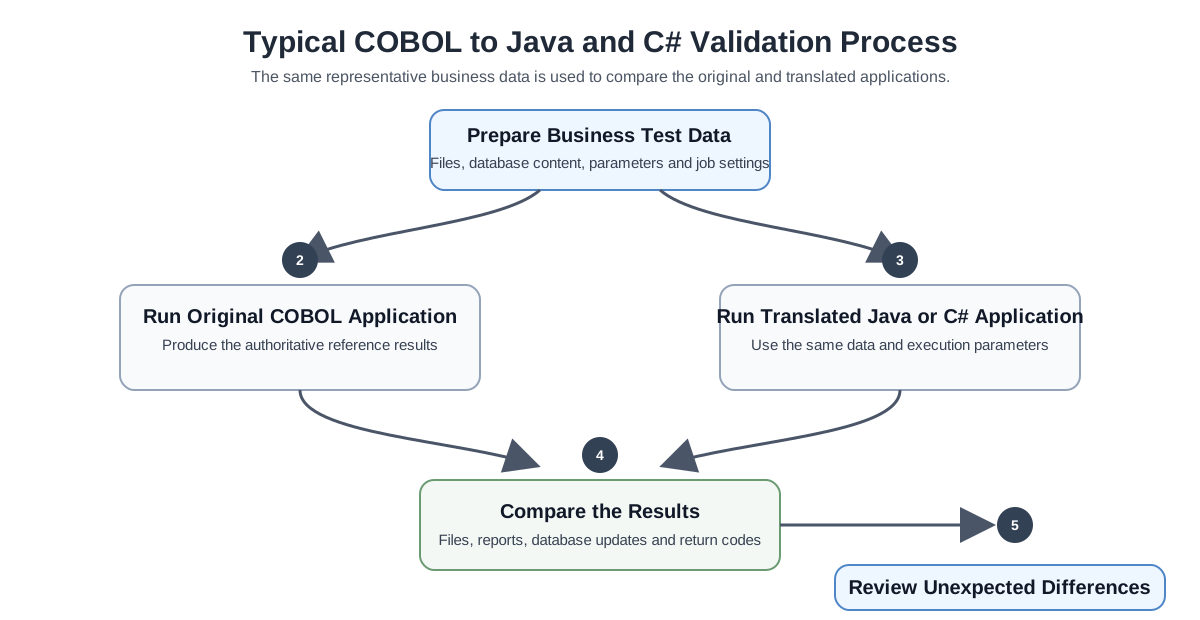
For COBOL batch applications, testing is normally performed end-to-end using representative business data. The original COBOL program and the translated Java or C# application are executed with the same input files, database content and execution parameters. Where required, SoftwareMining utilities convert EBCDIC files to ASCII or Unicode and execute translated JCL through equivalent Windows or Linux scripts.
The results produced by both applications are then compared, including output files, reports, database updates, return codes and exception behaviour. Because the original COBOL application acts as the functional specification, successful comparison provides evidence that the translated application preserves the required business behaviour.
SoftwareMining uses an automated, rule-based translation engine that applies predefined conversion rules across the COBOL application. Equivalent COBOL constructs generate consistent Java implementation patterns, with optional C# generation, producing a uniform target architecture. This consistency supports code reviews, functional-equivalence testing and long-term maintenance because developers encounter familiar programming patterns throughout the converted system.
Common COBOL infrastructure is implemented within well-tested SoftwareMining runtime libraries rather than repeatedly generating identical code in every translated program. File handling, database access, transaction management and data conversion are therefore implemented once and reused throughout the application.
For example, every COBOL OPEN, READ, WRITE and CLOSE operation is translated into the same runtime library calls throughout the application.
This reduces generated code, improves maintainability and allows testing to concentrate on the translated business logic.
For a technical comparison of AI-assisted modernization and SoftwareMining's non-AI, rule-based COBOL translation approach, see the Claude Code Technical Evaluation for Enterprise COBOL Modernization .
Additional testing may still be required for the target environment, including performance, security, deployment, integration and operational testing. These activities are separate from functional-equivalence testing and would normally be required for any significant platform change.
Once the converted application has been accepted, subsequent enhancements are normally made directly to the Java source code, or C# where selected. Generative AI output may vary between runs or after prompt and model changes. By contrast, SoftwareMining applies predefined translation rules consistently. The same COBOL source, translator version and configuration produce consistent implementation patterns, supporting repeatable validation across the application and subsequent translation cycles.
Functional-equivalence testing provides a practical and auditable way to validate COBOL modernization. By executing the original and converted applications with the same representative business data, organizations can compare observable results and investigate differences before production deployment. SoftwareMining's predefined, repeatable translation patterns and supporting conversion and comparison utilities enable consistent validation across large COBOL-to-Java projects, with optional C# generation.
If you are evaluating approaches to enterprise COBOL modernization, these resources provide further guidance on strategy, planning, migration and testing:
 Download PDF: COBOL-to-Java and C# Testing Strategy