
SoftwareMining •
COBOL to Java & C#
• Predictable & Repeatable
Organizations considering private generative AI for COBOL modernization must account for the infrastructure, engineering, governance and ongoing operating costs involved, not simply the cost of hosting a language model.
This guide examines the infrastructure, engineering and operating costs of building and maintaining that capability. It also compares private AI with SoftwareMining's downloadable, non-AI, rule-based COBOL-to-Java and COBOL-to-C# Conversion Toolkit .
The SoftwareMining Toolkit operates within the customer's own infrastructure and uses predefined rules to generate predictable, repeatable and auditable Java or C# source code. Enterprise customers and systems integrators can download and evaluate the Conversion Toolkit using representative COBOL programs.
COBOL applications may contain sensitive business logic, customer data, financial calculations and operational processes. Organizations in regulated sectors may therefore prefer a private AI environment that provides control over:
Most organizations would host a pre-trained model rather than train one from scratch. Private hosting provides greater control, but does not by itself ensure complete conversion, repeatable output or functional equivalence with the original COBOL application.
A private AI modernization platform typically requires the following capabilities in addition to the language model:
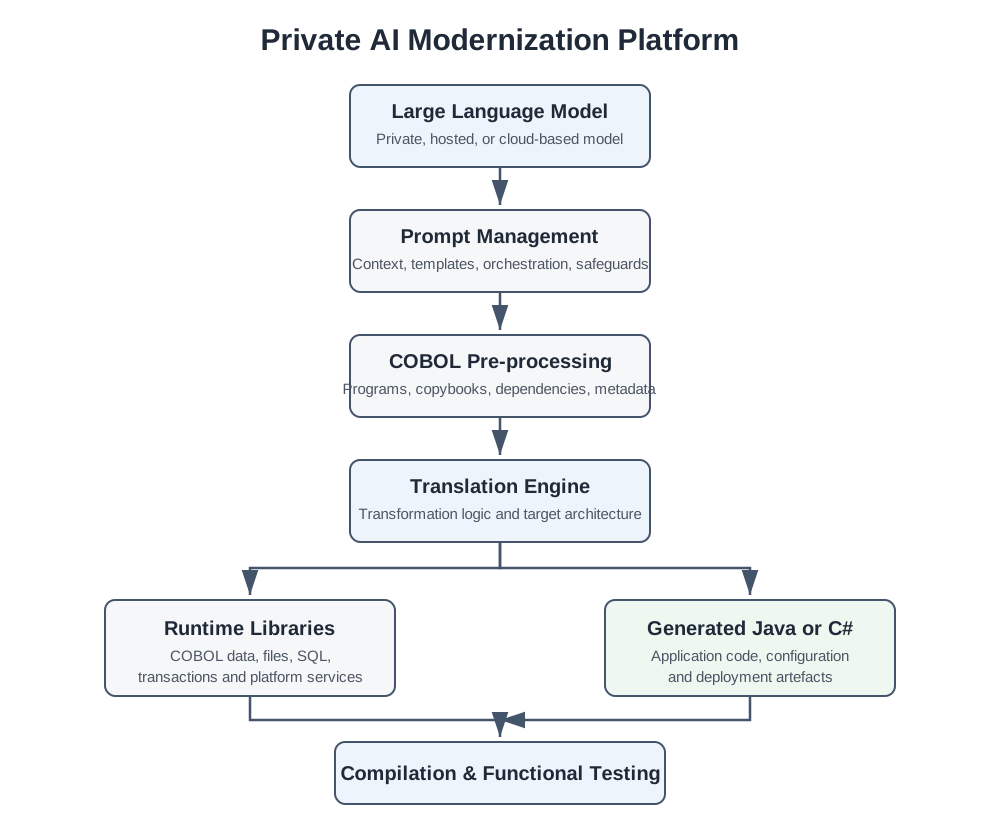
Private AI costs extend beyond model licensing. Organizations must fund the infrastructure, engineering, validation, governance and continuing operation of the complete modernization platform.
These costs should be evaluated across the expected life of the platform. See our comparison of COBOL modernization costs and ownership models .
Java and C# do not natively provide every COBOL language behaviour or mainframe platform service. A private AI modernization platform must therefore generate or supply runtime components for required data handling, file access, database integration and transaction processing, and support them throughout the converted application's operational life.
SoftwareMining's COBOL-to-Java and COBOL-to-C# Conversion Toolkit includes established runtime libraries for supported COBOL and mainframe behaviour, reducing the need to build a runtime architecture internally. These libraries remain part of the converted application's architecture and should be considered when evaluating support, governance and long-term platform dependency .
Private hosting can address data-sovereignty concerns, but does not by itself demonstrate that generated applications are correct, repeatable, supportable or ready for production. Governance should address:
Validation should compare the converted and original applications using representative business data, including reports, files, database updates, screen behaviour, return codes and exceptions. SoftwareMining's rule-based conversion and comparison utilities support this process. See functional-equivalence testing for converted COBOL applications .
The appropriate approach depends on whether the objective is to build and maintain an internal AI capability or to modernize a specific COBOL application portfolio using an established conversion platform.
| Evaluation area | Private AI platform | SoftwareMining Conversion Toolkit |
|---|---|---|
| Platform preparation | The organization selects and hosts the model and develops the discovery, orchestration, validation and governance environment. | Application analysis, conversion workflows, target mappings and runtime libraries are provided. Project-specific configuration remains necessary. |
| COBOL expertise | COBOL, CICS, IMS, JCL, database, file and target-language expertise must be supplied by the organization or specialists. | Supported platform knowledge is incorporated into predefined conversion rules, mappings and runtime libraries. |
| Repeatability | Results may vary with the model, prompt, context and configuration. Repeatability must be designed and tested. | The same source, tool version and configuration produce consistent target structures using predefined rules. |
| Infrastructure | Model hosting, compute resources and specialist operational support are required. | Conversion runs within client infrastructure without dedicated GPUs or a permanently hosted private LLM environment. |
| Data control | Source code can remain internal when model hosting, supporting services and access controls are configured accordingly. | Analysis and conversion run within the client's environment, keeping source code and business data under client control. |
| Validation | Compilation, comparison and functional-equivalence capabilities must be developed or integrated. | SoftwareMining provides comparison utilities and repeatable conversion patterns. Customer testing remains essential. |
| Cost and ownership | Costs include model licensing, compute, platform engineering, security, validation and continuing AI operations. | Costs include toolkit licensing, conversion, runtime support, integration and customer testing without operating a private AI platform. SoftwareMining maintains the supported tools and runtime libraries. |
SoftwareMining provides an established, non-AI, rule-based route to Java or C# without requiring an organization to build a private AI platform solely for COBOL conversion. The toolkit can be evaluated using representative programs before a wider modernization project begins.
A private AI platform can keep sensitive source code and modernization data within controlled infrastructure, but its viability depends on the surrounding engineering, runtime, validation, security and governance capabilities, not code generation alone.
Building this platform may be appropriate when the strategic objective is to establish an internal AI engineering capability. When the objective is controlled enterprise COBOL conversion, SoftwareMining's established, non-AI, rule-based COBOL-to-Java and COBOL-to-C# Conversion Toolkit provides a more direct route to evaluation and implementation.
Explore SoftwareMining's approach to automated, rule-based COBOL-to-Java modernization, technical evaluation and functional-equivalence testing.